Sunday, March 17, 2019

Engineered gold nanoparticles can be like ice cream scoops covered in chocolate sprinkles

There are many ways to interrogate molecular phenomenon. You might think that this is restricted to physical measurements such as direct observation with a microscope, a laser, or more seemingly arcane observation with nuclear magnetic resonance (NMR). But I’m happy to report that observation of computer simulations is yet another, as long as our models are sufficiently accurate that they mimic reality perfectly. In today’s age when it’s hard to see the difference between CGI and real humans, this may not sound surprising. Nevertheless, the question is what can we learn from observation of real and simulated systems in tandem?

I’m happy to report that my student Gene Chong and Cathy Murphy’s student Meng Wu did precisely this parallel study. Gene made simulations of a simpler system, involving nanoparticles covered by lipids called MUTABs. Meng made NMR measurements of nanoparticles covered by a similar but somewhat longer lipids called MTABs. (Note that if you are worried about the term nuclear in NMR, as in nuclear energy, don’t be. We are just looking at the positions of the nuclei, not spitting them apart. It was the concern over this misunderstanding that led to the use of such a device to look at your body in detail to be called MRI instead of NMR!) The happy result was that the two observations agreed. But only together did Meng’s and Gene’s observations show clearly that the lipids didn’t always cover the nanoparticle smoothly like melted chocolate on ice cream, but rather assembled like sprinkles all pointing out in the same direction packed together in different islands on the surface. This structure means that lipid-decorated nanoparticles will have shape and response to other systems that you might not otherwise anticipate. And this opens the question to our next set of investigations as we chart a course to understand the interactions between nanoparticles and biological components such as membranes.

If you want more detail, check out our article in JACS, just recently published!  That is, JACS 141, 4316 (2019), and I'm happy to report that it was funded by the NSF CCI program for our Center for Sustainable Nanotechnology.

Tuesday, March 5, 2019

Deleted edits from my Comment on diversity and inclusion


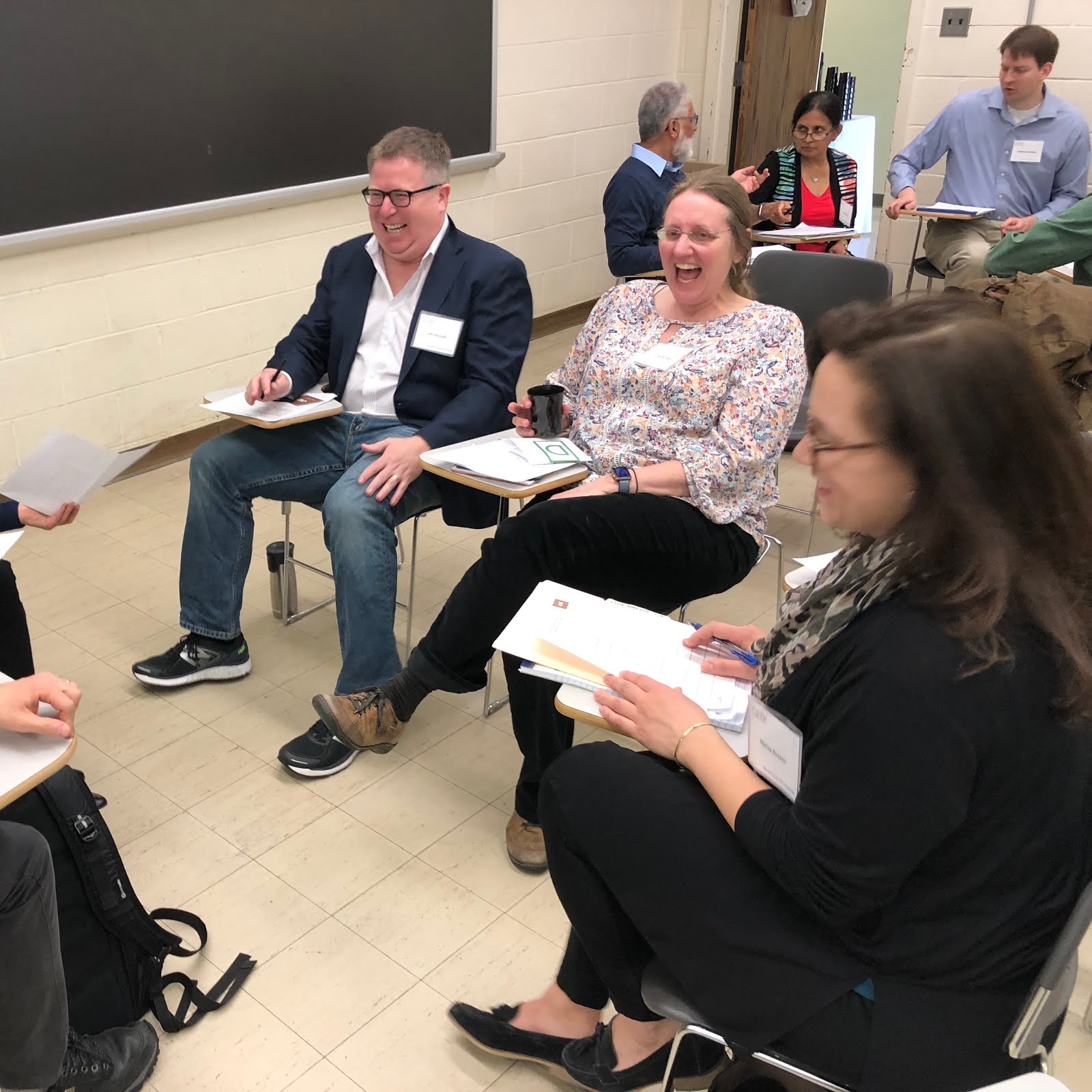
When writing a Comment in any magazine, you invariably have a word limit. It's also important to stay on message so that readers won't get lost in the weeds. Thankfully, C&EN has great editors, and it was a pleasure to work with them to write my recent Comment (details at bottom) to help me stay on message. Indeed, while I appreciate the power of blogging and writing unfettered, there is great value in a strong editor. I am thankful that we still have them in the publishing world. In case, though, you want to see some of the weeds that got cut out, here's your sneak peak:

"An evocative triple or triad for managing diversity and advancing inclusive excellence is Support. Compliance, and Adjudication."

"Compliance is necessary in today’s world because we have seen that without it, systems tend to move out of whack, but it tends to be seen to be about protecting an administration from legal attacks."

"Adjudication provides a mechanism to resolve conflicts between aggrieved parties, but who decides which party is in the right or wrong, and how can we be sure that they are fully supporting the individuals fairly."

"Does a member trust us an authoritative source of information? Does a member trust us to prepare them throughout their professional career progression? Does a member trust us even when we tell them that they are wrong? If we are to foster a healthy diversity culture within our Society, we need to be able to do all of this while still being a single organization."

"This [a workshop held at Barnard] included 1-point gains on a 5-point scale on four of the six objectives: (1) the difference and importance of transactional solutions vs. policy solutions as it pertains to managing diversity equity and inclusion, (2)  factors for administering recruitment, mentoring, tenure and promotion processes that advance inclusive excellence, (3) evidence-based strategies for addressing known barriers within a department so as to reduce existing diversity inequities, and (4) supporting and communicating inclusive excellence. Our targeted learning outcomes clearly resonate with the three legs of our managing diversity table and our approach to managing them. "

"The perhaps surprising outcome is that the practices necessary to manage diversity are simply the applications of good management to achieve a targeted outcome, which in this case is inclusive excellence."

"The courses offered by the ACS through the Leadership Advisory Board (LAB) where essential to me as I have developed as a leader, and I’m happy to recommend then to you so as to learn the underlying principles of management."

I also hope that you have a chance to read my recent Comment in C&EN on "Bringing diversity and inclusion to the ACS table." (Volume 97, Issue 9, March 2, 2019) If not, please check it out. Access is free if you are an ACS member. Otherwise, you can use one of your 5 free monthly views... And if you are a chemist, please consider joining.


Friday, September 30, 2016

On celebrating my 11th and last Herty Medal Dinner as Host

The Georgia Local Section of the American Chemical Society has a deep history in recognizing research and service toward the advancement of chemistry in the nation’s service. The first of the Herty Medals was awarded in 1933 to Fred Allison. Charles Herty was honored with the award in the following year. As of September 16th of this year, we have now awarded 82 gold medals to deserving chemists in the southeastern United States. The most recent Medalist was Prof. Brooks Pate from the University of Virginia who was recognized for "his work in revolutionizing molecular rotational spectroscopy and its applications in astrochemistry and analytical chemistry and for his service in mentoring diverse students through a summer undergraduate research program.” His seminar illustrated how his key insight of spectral theory allowed him to develop an approach for capturing the spectra in a single experiment rather than using a series of single frequency measurements. The speed and accuracy of this technique has played a key role in reimagining the field of astrochemistry.

On a personal level, I was pleased to see Brooks again after we had been lab mates in Kevin Lehmann’s laboratory at Princeton. I was an undergraduate while I saw him sail through his candidacy exams. On a different personal level, this most recent Herty Medal dinner also marked the eleventh and last dinner for which I chaired the corresponding selection committee. The list of nominees is outstanding and this made settling on a finalist all the more difficult each and every year. Nevertheless, with the able help of my committee colleagues, we developed a process that allowed us to sort through the nominees carefullly and thoughtfully. We pre-screened all of them electronically prior to our in-person meeting. The two- to three- hour discussion led to a deeper understanding of the candidates, and often resulted in a final choice which our individual assessments had rarely predicted. During my term as Chair of the Herty Medal Selection Committee, we also had the opportunity to do up the 75th Herty Medal celebration. For the fist and only time, we have nearly 15 Herty Medalists return to Atlanta to commemorate them and chemistry in the Southeastern United States. We staged several one-time activities reaching out to students and professionals of all ages. We founded the Herty Medal Undergraduate Research Symposium (HMURS), and it continues to support our Section’s diverse undergraduates. I am thus very proud of what our Section has accomplished, and thankful to the section for letting me be a part of it. I also look forward to celebrating the 100th Herty Medalist in 2034. Mark your calendars now!

Thursday, September 29, 2016

The talking head video for my District IV Director campaign

You may recall my recent post on the making of a video segment for my District IV Director election campaign. Well now you can see it...

Check it out here!

And the election window is coming up... It runs from October 1 to October 30! So if you are an ACS Member living in the SouthEast please vote. Whether you vote for me or not, I will be happy to represent you, if elected. I also welcome your thoughts on how to mate the American Chemical Society a better society for all of us!

Monday, September 12, 2016

District IV Director's Candidate Statement in CEN

As some of you may know, I am running to continue into my second term on the Board of Directors of the American Chemical Society (ACS). The candidate statements have just appeared in the September 12th issue of C&EN, and I reproduce mine below. The text is also available on my website. If you are a member of the ACS and a member of District IV (roughly in the SouthEast of the US), I would very much appreciate your vote!

Some of you may wonder why I volunteer for the ACS. After all, it takes roughly 160 hours of my time each year to serve the ACS as a Director. That's time that I could be devoting to my research, my students, or (most importantly) my family. Yes, like you, I multi-task and make it work. But the question is why? And the answer is simply that it gives me the opportunity to shape our ACS into a society that works for all of us. My roles as an active research professor, who engages in grants and contracts from government agencies, foundations and industry, gives me currency in the use of many of our offerings. I see directly (through my undergraduate, graduate and postdoctoral) students the impact of our career services. As a computational chemist and journal author, I am directly familiar with our journals and electronic platforms for communication. Unfortunately, the Board has traditionally been under-represented by members who are still active in their careers and could provide a balancing perspective for the emerging challenges to our members and our society. For this reason I have felt compelled to serve you on the Board, and I ask that you vote for me so that I may continue doing so.

My Candidate Statement:

The most important element in ACS membership is you. Every one of us, cross-linked together through ACS, makes up a personal and professional chemistry network that we can leverage to advance our careers, each other, and chemistry as a whole. Through ACS, we can celebrate that chemistry has a human side, and it must be diverse. The challenge lies in continuing to adapt our structure and our offerings to best serve the broad needs of our fellowship. This is a challenge that cannot be solved once and for all because we, and the world around us, are constantly changing. The opportunity for advancing the interaction and support of chemical scientists like you is what drove me to volunteer to serve as district director, and it is why I would like to continue for another term.  

Ihave focused on three of ACS’s core values: the value proposition of ACS membership, education of the chemical workforce, and science advocacy. The diversity in age, experience, background, worldwide location, race, ethnicity, gender identity and orientation, and ability that makes our fellowship stronger must be addressed through these values and everything we do. My championing of diversity equity on task forces and boards and as the director of OXIDE (Open Chemistry Collaborative in Diversity Equity) demonstrates my strong commitment to advancing these critical issues within the chemical workforce. As a director, I have spoken with many of you at regional and national meetings, and I wrote two comments inI have focused on three of ACS’s core values: the value proposition of ACS membership, education of the chemical workforce, and science advocacy. The diversity in age, experience, background, worldwide location, race, ethnicity, gender identity and orientation, and ability that makes our fellowship stronger must be addressed through these values and everything we do. My championing of diversity equity on task forces and boards and as the director of OXIDE (Open Chemistry Collaborative in Diversity Equity) demonstrates my strong commitment to advancing these critical issues within the chemical workforce. As a director, I have spoken with many of you at regional and national meetings, and I wrote two comments in C&EN—July 14, 2014, pg. 45 and August 24, 2015, pg. 40,—promoting diversity equity and inclusive excellence.

ACS remains as relevant and necessary today as when it was founded, despite the flattening in accessing information through the internet. As members, you and I are voting affirmatively with our wallets, declaring that chemistry and our network are important. Through this collective action, we are empowering ourselves as a force for change in areas such as energy, sustainability and human health. Nevertheless, our Society, like many others, is facing the challenge of decreasing membership. This is a tide that we must stem. Our size gives us the diversity we need to advance our science. It also signifies a vote of confidence for all of our advocacy and outreach activities. As an ACS Director, I will remain a strong proponent for providing clarity to the value proposition of our membership to each of our present and future members.

Diversity of the emerging chemical workforce translates into a need for using multiple mechanisms in and out of the classroom to engage students in the educational process. As a Phi Beta Kappa lecturer, I have had the opportunity to engage, motivate, and mentor undergraduates though campus visits that provide small-group interactions going well beyond my classroom. (Check out undergraduate Linsey Liles’ recap of my visit to the University of the South in the Key Reporter.) If elected, I hope to continue such visits by engaging local chapters as hosts. I am also keenly aware for the need to continue professional education. I have been involved as a facilitator in the Cottrell Scholars Collaborative New Faculty Workshop (C&EN, March 24, 2014, pg. 36). I am also leading a team organizing the Academic Leadership Workshop aimed at supporting midcareer faculty to become university administrators or research directors (C&EN, March 7, 2016, pg. 47). These programs illustrate the power of ACS to catalyze educational opportunities for chemical scientists throughout our lives.

Advances in chemical science and innovation depend critically on public and private support. Advocacy for such efforts can succeed only if we make our science understandable to the public. It is particularly critical for advancing high-risk, high-potential science that tends to receive less funding when budgets are tight (C&EN, September 21, 2015, pg. 33). Again, ACS as a professional society is uniquely positioned to provide current understanding of science and to advocate for the chemical challenges that still remain to be understood. I have enjoyed working with ACS staff in advocating for chemical science and the people who do that work.


Through these priorities, I will aim to help our society become a better home for ts members and a more effective partner to the world. The resonating thread that we must advance through these and other initiatives is you. ACS programs can be effective only if they serve your needs and advance your goals. To this end, I look forward to hearing from you through links at http://tinyurl.com/hernandez4acs to learn more about how to make our ACS fellowship even stronger. I also ask for your vote so that I may continue to work with you and our fellow ACS members to improve your ACS. 

Monday, August 22, 2016

Video Segment on my Candidacy for District IV Director

This Fall, I am running to continue into my second term on the Board of Directors of the American Chemical Society (ACS). As part of our effort to communicate with members, a 2-3 minute video segment of me discussing my vision for the ACS was just recorded today. I'm including the transcript of that statement below so as to give you a spoiler for the video! Feel free to send me your thoughts and suggestions for increasing the value of the ACS to you and chemistry broadly. If you are a member of the ACS and a member of District IV (roughly in the SouthEast of the US), I would also very much appreciate your vote!

Here's the transcript:

The most important element in ACS membership is you. Together we form a personal and professional chemistry network that we all leverage to advance our careers, each other, and chemistry as a whole. Through ACS we celebrate the technical and human sides of chemistry, and both must be diverse. 

The challenge lies in continuing to adapt our structure and our offerings to best serve the broad needs of hour fellowship. This is a challenge that cannot be solved once and for all because we and the world around us are constantly changing. The opportunity for advancing the interaction and support of chemical scientists like you is what drove me to volunteer to serve as District Director, and it is why I would like to continue for another term.

I have focused on three of ACS’s core values: The value proposition of ACS membership, Education of the chemical workforce, and Science advocacy. The diversity in age, experience, backgrounds, world-wide location, race, ethnicity, gender identity and orientation, and special abilities that makes our fellowship stronger must be addressed through everything we do. My championing of diversity equity on task forces, boards and as the OXIDE Director demonstrates my strong commitment to advancing these critical issues within the chemical workforce. As a Director, I have spoken with many of you at regional and national meetings. I have written several comments in C&EN, promoting diversity equity and inclusive excellence, the integration of teaching and research, and advocacy for public understanding and financial support of the chemical sciences. 

The ACS promotes and advances chemical science and innovation through its on-line platforms, journals, abstract services, conferences, and more. The ACS is also here to help you and all of its members grow professionally through our myriad of educational offerings. All of these programs and offerings are critical in establishing a marketplace of ideas to which you as a member have a privileged entrĂ©e while benefiting from the broad scope or our large membership. As a member-driven society, none of these things can happen without you. So I ask that you join me in advancing our society. Contact me electronically or personally through the links at tinyurl.com/hernandez4acs follow me on twitter at EveryWhereChem, or read my posts at EveryWhereChemistry.blogspot.com. VOTE for me, Rigoberto Hernandez, so that I may work with you and our fellow members to advance your ACS.

Remember… Every Vote Counts!


Thursday, August 18, 2016

Diversity in the Marketplace of Ideas

During my Phi Beta Kappa visit to University of Oklahoma back in late March of this year, my host Ron Halterman added a somewhat unusual meeting to my visit. Namely, he arranged for me to go to a recording studio at the local NPR station, KGOU. While there, I had a conversation with Paige Willett Lough and Merleyn Bell on the work that I’ve been doing to promote diversity equity in chemistry through OXIDE. In much less than an hour, they recorded enough material to produce a 30-minute show as part of their Race Matters series. At first, it wasn’t clear to me who was more nervous, Merleyn or me. I’m pretty sure that it was me, and Merleyn pretended to be so just to make me adjust to the fact that I was staring at a very large microphone. In any event, it was fun to have a conversation about diversity equity and science advocacy, and I thank Ron, Merleyn and Paige for making that happen!

A 30-minute conversation includes a very long narrative that is too long to reproduce here, but I can highlight a few of the points to hopefully peak your interest. (Or you can just use this as your “cliff notes” so as to avoid going further!) The notion that we as scientists are competing in a marketplace, not of physical products, but of ideas is one that intrigues me. We develop and disseminate ideas but it’s hard to own or sell them. Yet it costs money to produce and maintain them. That money comes from the federal government or student tuition, for example. It leads to solutions and products that we all use and pay for. So it’s definitely a marketplace which has real value. For us to remain competitive in this marketplace of ideas, we need to have a diverse cohort of scientists, and this notion frames several of the segments of my discussion. Indeed, it is the need for us to remain competitive in science that drives OXIDE in its work to diversity the faculties in chemistry departments across the US. As a community, we have made significant advances in changing our policies and procedures to advance our climate, and I provided several specific examples. Meanwhile, Merleyn also asked me about how I encourage young people to be scientists. I hope that I do this by example, and by actively engaging and mentoring students when I visit colleges and universities. But scientists need help from the media to amplify our message. To this end, I mentioned that the theme in the “The Martian” —in which science was used frequently as the key to solve his challenges— is a great example of the media promoting science, and not just innovation.